

Understanding fractions can seem daunting, but they play a crucial role in everyday math. When it comes to calculating portions, knowing how to find 1/5 of a number like 20 can simplify many tasks, from cooking to budgeting.
In this article, we’ll break down the concept of fractions and demonstrate how to easily calculate 1/5 of 20. This simple yet essential skill will empower readers to tackle more complex math problems with confidence. Whether you’re a student or just brushing up on your math skills, mastering this calculation is a step toward greater numerical fluency.
Understanding Fractions
Fractions represent a way to describe parts of a whole. Understanding fractions allows individuals to perform various calculations and make sense of numeric relationships in everyday situations.
What Are Fractions?
Fractions consist of two numbers: the numerator and the denominator. The numerator indicates how many parts are being considered, while the denominator shows the total number of equal parts in the whole. For example, in the fraction 1/5, 1 is the numerator, and 5 is the denominator. This fraction means one part of a whole divided into five equal parts. Understanding fractions forms the basis for more advanced mathematical concepts, such as ratios and percentages.
How to Calculate Fractions
Calculating fractions involves several straightforward steps.
- Identify the Fraction: Recognize the numerator and denominator.
- Convert the Whole Number: For calculations like 1/5 of 20, turn the whole number into an equivalent fraction (20 becomes 20/1).
- Multiply the Fractions: Multiply the numerator of the first fraction by the numerator of the second fraction, and then multiply the denominators.
- Simplify the Result: If applicable, simplify the resulting fraction to its lowest terms.
For example:
- Take 1/5 and 20/1.
- Multiply: (1 times 20 = 20) and (5 times 1 = 5), giving (20/5).
- Simplifying (20/5) results in 4.
Calculating fractions requires practice, but mastering basic operations lays the foundation for working with more complex mathematical concepts.
Exploring 1/5 of 20
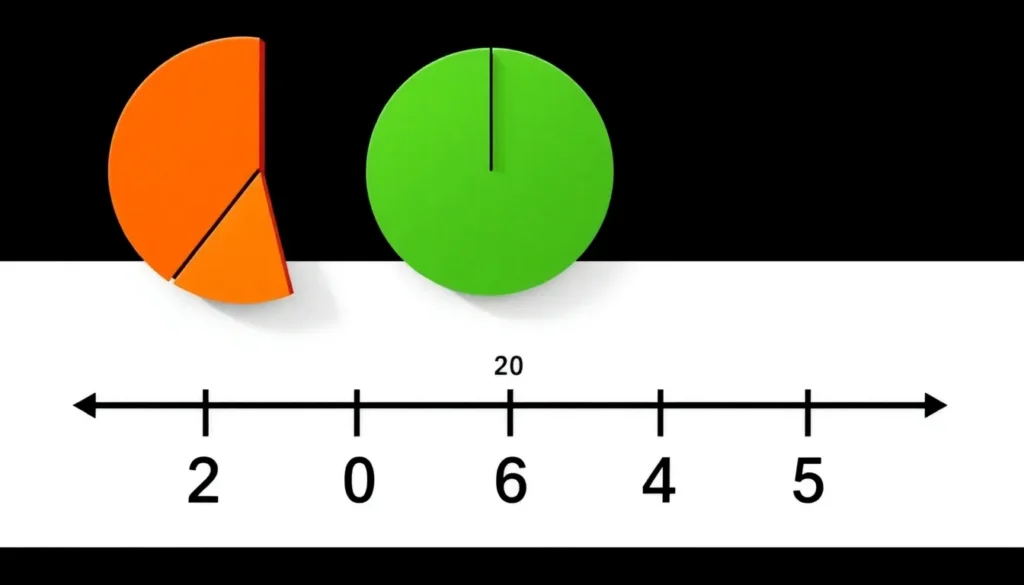
Calculating 1/5 of 20 provides a practical example of working with fractions. This section breaks down the calculation and visualizes the concept for clearer understanding.
Breaking Down the Calculation
To determine 1/5 of 20, follow these steps:
- Identify the fraction: 1/5.
- Convert the whole number into a fraction: 20 becomes 20/1.
- Multiply the fractions: (1/5) × (20/1) = 20/5.
- Simplify the result: 20 divided by 5 equals 4.
These steps demonstrate that 1/5 of 20 equals 4, emphasizing the straightforward approach to fraction calculations.
Visualizing the Concept
Visualizing fractions aids in comprehension. Consider a pie divided into five equal slices, representing 1/5. If one slice is taken from a total of 20 slices (like 20 as a whole), that single slice reflects the calculation result.
Alternatively, a number line can illustrate this concept. Mark the number 20 on the line and divide it into five equal parts. Each part represents 4, demonstrating visually how 1/5 of 20 equals 4. This method enhances the grasp of fractions and their relation to whole numbers.
Practical Applications of 1/5 of 20
Understanding how to calculate 1/5 of 20 finds numerous real-world applications. These mathematical skills facilitate better decision-making in various aspects of life.
Real-Life Examples
1/5 of 20 plays a crucial role in budgeting. When dividing a $20 bill among five friends, each one contributes $4. This straightforward division ensures fairness in shared expenses.
Cooking provides another example. A recipe calls for 20 ounces of an ingredient, and one friend wants to prepare just 1/5 of the dish. This friend needs 4 ounces to align with the recipe’s proportions.
Another example arises in education. A student studies for 20 hours for an exam. By dedicating 1/5 of that time, the student invests 4 hours into a specific subject, enabling focused preparation and efficient learning.
Importance in Everyday Situations
Calculating 1/5 of 20 proves essential in many everyday scenarios. This foundational skill aids in estimating quantities, ensuring accuracy in tasks like cooking or shopping.
In finance, this calculation assists individuals in managing personal budgets effectively. Knowing that 1/5 of $20 equals $4 allows for precise allocation of funds.
Moreover, organizing events often involves this computation. If 20 invitations are sent out, RSVP management might require tracking 1/5 of the responses, translating to 4 confirmed attendees.
Understanding fractions like 1/5 of 20 lays the groundwork for navigating more complex mathematical scenarios, thus enhancing overall numerical fluency and confidence in practical applications.
Common Misconceptions
Misconceptions about fractions often hinder a clear understanding of mathematical concepts. Clarifying these misunderstandings fosters better numerical fluency and confidence in everyday calculations.
Misunderstanding Fractions
Many individuals confuse fractions with whole numbers, viewing them as less significant. Fractions represent parts of a whole, and understanding this concept is crucial. For example, when considering 1/5 of 20, it’s essential to recognize that 1/5 means dividing the number into five equal parts, not merely taking a portion of a whole number. Additionally, some may overlook the role of the denominator in determining the size of each fraction. Knowing that a smaller denominator increases each fraction’s value aids in grasping their impact in various contexts.
Mistakes in Calculation
Common mistakes often occur during fraction calculations. For instance, many mistakenly add or subtract fractions instead of multiplying when determining 1/5 of 20. Properly converting whole numbers into fractions ensures accurate results. When calculating 1/5 of 20, it’s vital to express 20 as 20/1 and then perform the multiplication. Neglecting to simplify the fraction can lead to incorrect conclusions; thus, arriving at the final answer, 4, requires careful attention to detail throughout the calculation process.
Understanding how to calculate 1/5 of 20 is more than just a basic math skill. It’s a valuable tool that can simplify daily tasks and enhance overall numerical fluency. Whether dividing expenses among friends or adjusting recipes, this knowledge proves practical and essential.
By mastering the steps involved in fraction calculations, individuals can build confidence in their mathematical abilities. This foundational skill not only aids in everyday scenarios but also prepares learners for more complex concepts in mathematics. Embracing fractions as significant parts of a whole can transform one’s approach to numbers and their applications in real life.
